
What is the Pipeline?
The Pipeline tool built into Fuse is a strong sales enablement solution. The Pipeline allows you to effectively manage leads, track progress, and optimize your agency's sales process. A successful sales pipeline helps turn leads into clients by sending personal, meaningful, and relevant messages tailored to each lead's interests.
The Pipeline tool is not designed for mass communication; instead, think of the tool as a way to nurture leads through various stages of the sales process. To get the best results, focus your pipeline on individualized interactions that add values to your leads.
If you'd like a getting started guide for the Fuse Pipeline tool, check out this Help Center article.
What Defines Quality Lead Management?
Lead management is the backbone of growing your business. Every lead is a chance for new business, and engaging quickly can make all the difference. It’s not just about the first contact—it’s about creating a smooth process that turns prospects into clients, using technology to make things easier.
Consistent follow-up communications are essential in meeting expectations and demonstrating professionalism. Regular engagement not only builds trust but also reassures prospects that your agency is committed to addressing their needs.
How to manage insurance leads on a daily basis
- Step 1: Track inbound lead flow. Make sure someone is responsible for checking leads throughout the day and getting notified right away. This ensures no lead is missed and each gets the attention it deserves.
- Step 2: Conduct lead research. Before reaching out, do some basic research to understand who the lead is and why they’re reaching out. This helps tailor your approach and enhances engagement.
- Step 3: Contact the lead. Reach out within 5 minutes, or at least within an hour. Quick contact keeps the lead interested and moves them through the pipeline.
- Step 4: Follow-up steps. After initial contact, move the lead to the next stage with follow-ups like calls, emails, or texts. Regular follow-ups show your commitment to meeting their needs.
- Step 5: Close the deal. Work the lead through the pipeline stages and aim to close the deal as either won or lost. Effective closing ensures leads are converted into clients or managed appropriately.
- Step 6: Review the process. Regularly evaluate what’s working and what’s not to improve over time. This helps refine your process.
How do I access the Fuse Pipeline tool?
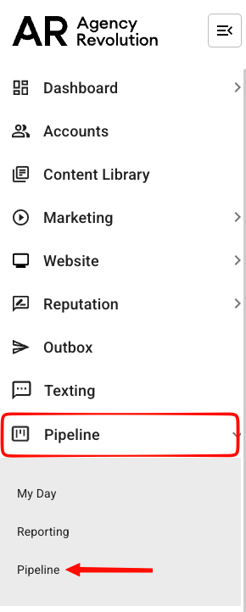
The Pipeline tool built into Fuse can be found on the left sidebar of your Agency Revolution workspace. Expand the sidebar and find the "Pipeline" option, then select "Pipeline" from the dropdown menu. This will take you to the main Pipeline board view.
What else is included with the Pipeline tool?
From the Pipeline dropdown, you'll see the option to select "My Day" and "Reporting," depending on your Agency Revolution workspace user level. Both of these tools are designed to help you work your sales leads and determine the effectiveness of your pipelines.
The My Day dashboard view, allows you to keep track of leads by due date so you never miss a sales opportunity. It gives you a simple way to track leads based on priority and gives you clear progress on your goals. To learn more about My Day, check out this Help Center article.
The Pipeline Reporting view allows Manager-level users to track leads and sales, and monitor agents’ workloads from one dashboard within Fuse. To learn more about Pipeline Reporting, check out this Help Center article.
How do I manage leads in the Pipeline tool?
Pipeline lead management is based on the main Pipeline board, where each lead has its own card, and each card can be manually moved from stage to stage within your pipeline. You can leverage Bulk Action Mode to move a large chunk of leads, or manage them overall. To learn about Bulk Action Mode, check out this Help Center article.
Pipeline Lead Cards
The bulk of the Fuse Pipeline page is made up of various lead cards in different stages of your pipeline. Each lead card represents a single lead, and each stage the card is in represents where that lead is in your agency's sales process.
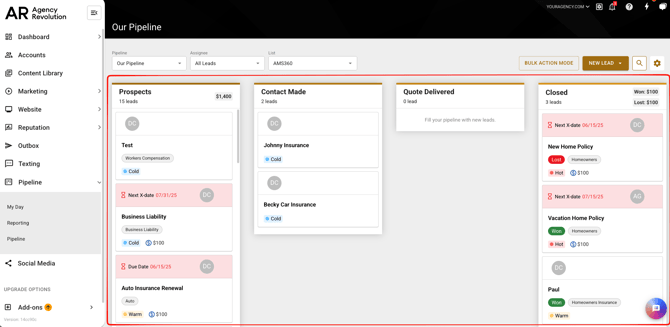
Manager-level users can see all leads within their agency's Fuse account. Agent-level users, on the other hand, can only see leads assigned to them. Leads can only be assigned to one person at a time. To learn more about user management and user roles in Fuse, check out this Help Center article.
Taking a closer look at a pipeline lead card...
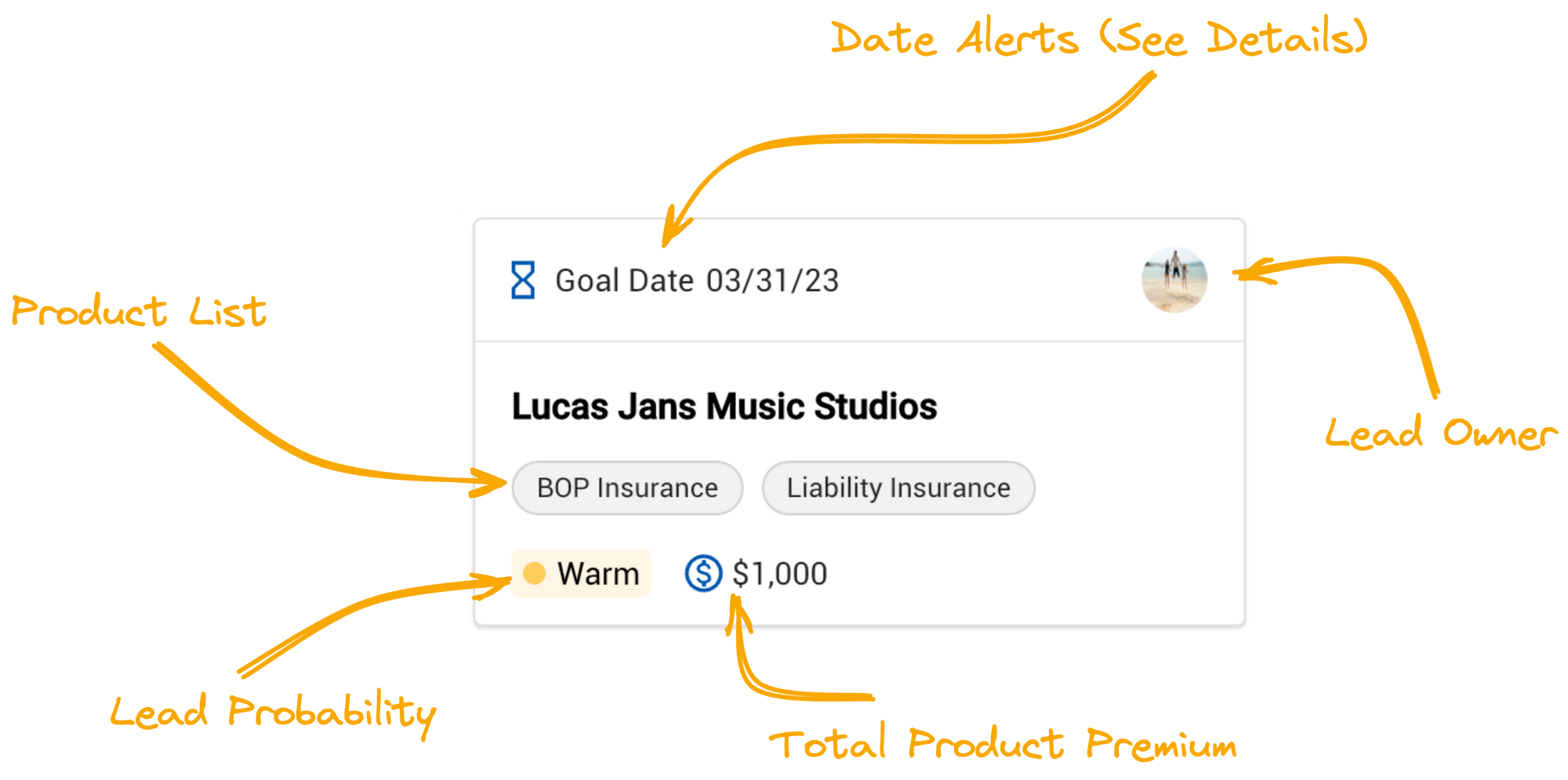
Each lead is represented by a Lead Card, which displays essential information:
-
Lead title: a descriptive internal name for this lead.
-
Lead probability: are we working with a warm or hot lead?
-
Lead owner: who at the agency owns nurturing this lead?
-
Due date alerts for the lead so no follow-ups are missed.
- Product Premium: a total dollar amount of potential premium attached to this lead.
-
Lead status: was this lead won or lost, and how much did we win or lose in premium?
Opening and Filling Out Your Lead Details
You can click on any lead card in any pipeline to open up the lead details page for that specific card. It's important to fill out as much detail for each lead card as possible. This helps you get the most out of My Day, our agent dashboard that helps your sales team stay on top of their leads and close more deals. To learn more about My Day, check out this Help Center article.
The lead details page captures comprehensive information about each lead, and gives you tools for managing that lead, including updating activities on the lead and adding notes about the lead to better help you sell.
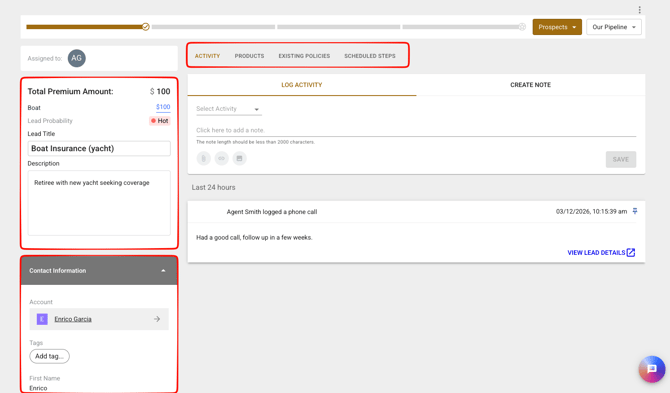
At the top of each lead details page, you'll see what stage the lead is in, respective to the specific pipeline you're working out of, and who that lead is assigned to at your agency. Next to the assignee, you'll see a few tabs: "Activity," "Products," "Existing Policies," and "Scheduled Steps."
Under the assignee, you'll find the high level lead details: the total premium amount, the products your lead is interested in, the lead's probability to close, and the lead title and description. Beneath that, you have a section to fill out the lead's contact information.
Activity Tab
Here, you can log phone calls, emails, and meetings with your lead. This helps you keep a record of the touches and how the lead nurturing is coming along. You can also create a note on this page, used for general record keeping about the lead itself.
Products Tab
Clicking on "Products" takes you to the specific tab where you can add and edit which insurance products your lead would like. In our example below, the agent is trying to close a deal for boat insurance.
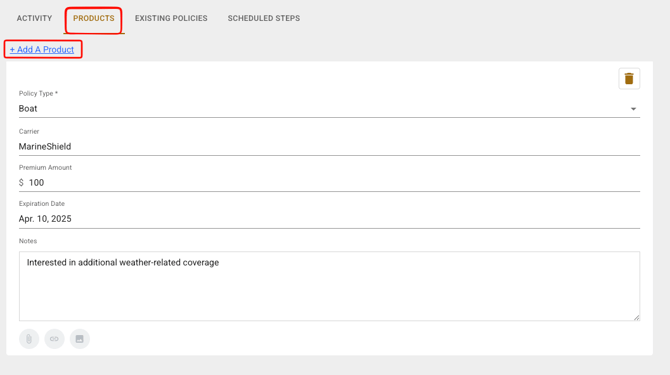
If they wanted to add an additional product, they would just click the "Add Product" button and fill out fill out the details. It is extremely important to add the "Premium Amount" field and catalog the potential premium for each lead. This helps you get the most out of the Pipeline tool!
Existing Policies and Scheduled Steps Tabs
The "Existing Policies" tab is useful for keeping track of any existing insurance coverages your lead has with your agency. If you're doing a cross-sell, it is great to check this tab to ensure you're aware of what business is already being done with your lead.
The "Scheduled Steps" tab shows any upcoming communications your lead will automatically be receiving if you're using our Pipeline Journeys feature. Learn more about Pipeline Journeys here.
Moving Leads Through Stages
When you drag and drop a lead from one stage to another, it will be displayed at the bottom of said stage. However, for the final stage of a pipeline, where a lead is marked either as Closed - Won or Closed - Lost, the last moved entry is sorted to the top.
Moving leads through stages is an important part of sales pipeline management, and when using Pipeline Journeys, moving a lead into a new stage triggers the automated communications to help ensure consistent follow-ups and engagement.
Manually Creating a Lead
Both managers and agents can create a new lead. Managers have the ability to assign the lead to someone, while agents can only create leads for themselves. When creating a new lead, users can search for existing contacts to avoid duplicates.
If a new contact is created, it will not automatically be added to the Agency Management System (AMS); it needs to be created separately in the AMS and linked via email address.
What Are the Ways I Can Add Leads to the Pipeline?
There are a handful of ways to add leads into the Pipeline tool. The below table breaks down every method of adding leads who expect to hear from you into your sales pipelines. Check out this Help Center article for more detail on these lead addition methods.
|
Goal |
Tool |
Details |
|---|---|---|
|
Adding Leads Via Website |
Fuse Form Integration |
Contact fills out form, form is connected to Pipeline, creates lead. |
|
Adding Leads Via Campaign Form |
Fuse Form Built Into Campaign |
Contact fills out form, form is connected to Pipeline, creates lead. |
|
Adding Bulk Lead Lists |
CSV Upload* |
Agency can upload clean list of contacts using template. |
|
Adding Leads Manually |
Manual Entry |
Agency can add individual leads manually. |
|
Adding Leads Via Segment |
Turn Accounts Into Leads Bulk Action |
Turn any segment into leads via bulk action within the segment. |
|
Adding Leads Via Campaign Lead Step |
Segment or Action Triggered |
Can be a step within larger campaign or standalone step triggered by segment change. |
To learn more about different ways to get leads into the Pipeline tool, check out this Help Center article.
How can I automate Pipeline management and prospecting?
The bulk of the lead management in the Pipeline tool is manual by design. This ensures you're giving proper attention and care to each sales lead in the system. While there is no means of automatically progressing leads through stages within a pipeline, you can automate communication by leveraging Pipeline Journeys.
What if I need more help with the Pipeline?
Our team is here to help you with most simple Pipeline requests. These include:
-
- Launching Pipeline Journeys: Need help launching a Quick Start Pipeline Journey? We're here to assist you.
- Updates to Steps: We can make minor updates to the steps in your existing Pipelines.
- Content for Steps: While we don't write content, we can guide you on using our FirstDraft AI tool or assist with minor edits to your Pipeline messages.
- Updates to Stages: Our Pipeline Journeys come with comprehensive Stages, but we can make minor adjustments to better align with your goals.
- User Access: Inform us about team members who need access, and we’ll set them up with Pipeline.
- CSV Uploads: We offer one-time assistance with CSV uploads to ensure you're confident in the process.
- Connecting Forms to Pipeline: Need assistance connecting a form to a Pipeline? We’re here to help. (Requires Fuse)
- Adding Fuse Forms to Forge Sites, and Connecting to Pipeline: For Forge Premium customers, using Fuse forms is key to automatically adding leads to a Pipeline. Our team can assist with these global changes. (Requires Fuse and Forge Premium)
- Pipeline Campaigns: If you need further automation, we can provide a one-time campaign setup or tutorial for you or your team. (Requires Fuse)
- Ongoing Education: Access our on-demand training videos and regular webinars for in-depth guides on using Pipeline.